siibra.commons
Constants, functions, and classes used commonly across siibra.
Attributes
Classes
Lookup table for instances of a given class by name/id. |
|
Identifies a unique region in a ParcellationMap, combining its labelindex (the "color") and mapindex (the number of the 3Dd map, in case multiple are provided). |
|
Generic enumeration. |
|
Simple polyline representation which allows equidistant sampling.. |
|
Generic enumeration. |
|
A simple typed namespace. At runtime it is equivalent to a plain dict. |
Functions
|
Compute the mutual information between two 3D arrays, which need to have the same shape. |
|
Estimate approximate isotropic scaling factor of an affine matrix. |
|
Given a nifti image object with four dimensions, returns a modified object |
|
clean up a region name to the for matching |
|
Compare two maps, given as Nifti1Image objects. |
|
Compute a 3D Gaussian kernel of the given bandwidth. |
|
Creates an uppercase identifier string that includes only alphanumeric |
|
|
Provide an iterator over masks of connected components in the given image. |
|
|
|
|
|
|
|
|
|
|
Converts a string in snake_case into CamelCase. |
Adds asterisks to strings that appear multiple times, so the resulting |
Module Contents
- class siibra.commons.CompareMapsResult
- correlation: float
- intersection_over_first: float
- intersection_over_second: float
- intersection_over_union: float
- weighted_mean_of_first: float
- weighted_mean_of_second: float
- class siibra.commons.InstanceTable(matchfunc=lambda a, b: ..., elements=None)
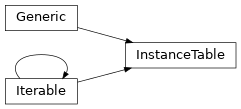
Lookup table for instances of a given class by name/id. Provide attribute-access and iteration to a set of named elements, given by a dictionary with keys of ‘str’ type.
- add(key: str, value: T) None
Add a key/value pair to the registry.
- Args:
key (string): Unique name or key of the object value (object): The registered object
- find(spec) List[T]
Return a list of items matching the given specification, which could be either the name or a specification that works with the matchfunc of the Glossary.
- get(spec) T
Give access to objects in the registry by sequential index, exact key, or keyword matching. If the keywords match multiple objects, the first in sorted order is returned. If the specification does not match, a RuntimeError is raised.
- Args:
spec [int or str]: Index or string specification of an object
- Returns:
Matched object
- provides(spec) bool
Returns True if an element that matches the given specification can be found (using find(), thus going beyond the matching of names only as __contains__ does)
- values()
- property dataframe
- class siibra.commons.LoggingContext(level)
- level
- class siibra.commons.MapIndex(volume: int = None, label: int = None, fragment: str = None)
Identifies a unique region in a ParcellationMap, combining its labelindex (the “color”) and mapindex (the number of the 3Dd map, in case multiple are provided).
- classmethod from_dict(spec: dict)
- fragment = None
- label = None
- volume = None
- class siibra.commons.MapType

Generic enumeration.
Derive from this class to define new enumerations.
- LABELLED = 1
- STATISTICAL = 2
- class siibra.commons.PolyLine(pts)
Simple polyline representation which allows equidistant sampling..
- length()
- sample(d)
- lengths
- pts
- class siibra.commons.Species

Generic enumeration.
Derive from this class to define new enumerations.
- static key_to_name(key: str)
- static name_to_key(name: str)
- CALLITHRIX_JACCHUS = 8
- CHLOROCEBUS_AETHIOPS_SABAEUS = 7
- HOMO_SAPIENS = 1
- MACACA_FASCICULARIS = 4
- MACACA_FUSCATA = 6
- MACACA_MULATTA = 5
- MUS_MUSCULUS = 3
- RATTUS_NORVEGICUS = 2
- UNSPECIFIED_SPECIES = 999
- class siibra.commons.TypePublication

A simple typed namespace. At runtime it is equivalent to a plain dict.
TypedDict creates a dictionary type that expects all of its instances to have a certain set of keys, where each key is associated with a value of a consistent type. This expectation is not checked at runtime but is only enforced by type checkers. Usage:
class Point2D(TypedDict):
    x: int
    y: int
    label: str

a: Point2D = {'x': 1, 'y': 2, 'label': 'good'}  # OK
b: Point2D = {'z': 3, 'label': 'bad'}           # Fails type check

assert Point2D(x=1, y=2, label='first') == dict(x=1, y=2, label='first')
The type info can be accessed via Point2D.__annotations__. TypedDict supports two additional equivalent forms:
Point2D = TypedDict('Point2D', x=int, y=int, label=str)
Point2D = TypedDict('Point2D', {'x': int, 'y': int, 'label': str})
By default, all keys must be present in a TypedDict. It is possible to override this by specifying totality. Usage:
class point2D(TypedDict, total=False):
    x: int
    y: int
This means that a point2D TypedDict can have any of the keys omitted.A type checker is only expected to support a literal False or True as the value of the total argument. True is the default, and makes all items defined in the class body be required.
The class syntax is only supported in Python 3.6+, while two other syntax forms work for Python 2.7 and 3.2+
- citation: str
- url: str
- siibra.commons.MI(arr1, arr2, nbins=100, normalized=True)
Compute the mutual information between two 3D arrays, which need to have the same shape.
Parameters: arr1 : First 3D array arr2 : Second 3D array nbins : number of bins to use for computing the joint histogram (applies to intensity range) normalized : Boolean, default:True
if True, the normalized MI of arrays X and Y will be returned, leading to a range of values between 0 and 1. Normalization is achieved by NMI = 2*MI(X,Y) / (H(X) + H(Y)), where H(x) is the entropy of X
- siibra.commons.affine_scaling(affine)
Estimate approximate isotropic scaling factor of an affine matrix.
- siibra.commons.argmax_dim4(img, dim=-1)
Given a nifti image object with four dimensions, returns a modified object with 3 dimensions that is obtained by taking the argmax along one of the four dimensions (default: the last one). To distinguish the pure background voxels from the foreground voxels of channel 0, the argmax indices are incremented by 1 and label index 0 is kept to represent the background.
- siibra.commons.clear_name(name)
clean up a region name to the for matching
- siibra.commons.compare_maps(map1: nibabel.Nifti1Image, map2: nibabel.Nifti1Image)
Compare two maps, given as Nifti1Image objects. This function exploits that nibabel’s get_fdata() caches the numerical arrays, so we can use the object id to cache extraction of the nonzero coordinates. Repeated calls involving the same map will therefore be much faster as they will only access the image array if overlapping pixels are detected.
It is recommended to install the indexed-gzip package, which will further speed this up.
- siibra.commons.create_gaussian_kernel(sigma=1, sigma_point=3)
Compute a 3D Gaussian kernel of the given bandwidth.
- siibra.commons.create_key(name: str)
Creates an uppercase identifier string that includes only alphanumeric characters and underscore from a natural language name.
- siibra.commons.iterate_connected_components(img: nibabel.Nifti1Image)
Provide an iterator over masks of connected components in the given image.
- siibra.commons.nonzero_coordinates(arr)
- siibra.commons.set_log_level(level)
- siibra.commons.siibra_tqdm(iterable: Iterable[T] = None, *args, **kwargs)
- siibra.commons.snake2camel(s: str)
Converts a string in snake_case into CamelCase. For example: JULICH_BRAIN -> JulichBrain
- siibra.commons.unify_stringlist(L: list)
Adds asterisks to strings that appear multiple times, so the resulting list has only unique strings but still the same length, order, and meaning. For example:
unify_stringlist([‘a’,’a’,’b’,’a’,’c’]) -> [‘a’,’a*’,’b’,’a**’,’c’]
- siibra.commons.HBP_AUTH_TOKEN
- siibra.commons.KEYCLOAK_CLIENT_ID
- siibra.commons.KEYCLOAK_CLIENT_SECRET
- siibra.commons.NEUROGLANCER_MAX_GIB
- siibra.commons.NZCACHE
- siibra.commons.QUIET
- siibra.commons.REMOVE_FROM_NAME = ['hemisphere', ' -', '-brain', 'both', 'Both']
- siibra.commons.REPLACE_IN_NAME
- siibra.commons.ROOT_DIR
- siibra.commons.SIIBRA_CACHEDIR
- siibra.commons.SIIBRA_DEFAULT_MAPTYPE
- siibra.commons.SIIBRA_DEFAULT_MAP_THRESHOLD = None
- siibra.commons.SIIBRA_LOG_LEVEL
- siibra.commons.SIIBRA_USE_CONFIGURATION
- siibra.commons.SIIBRA_USE_LOCAL_SNAPSPOT
- siibra.commons.SKIP_CACHEINIT_MAINTENANCE
- siibra.commons.T
- siibra.commons.VERBOSE
- siibra.commons.ch
- siibra.commons.formatter
- siibra.commons.logger = None